Anyone who has owned a good knife knows the disappointment of watching it go blunt faster than it should. Most of the time, the board gets the blame, and most of the time, that blame is fair. The construction of a chopping board has a direct effect on how long your knives stay sharp, and the difference between end grain and ordinary flat-grain boards is bigger than most people realise.
What “End Grain” Actually Means
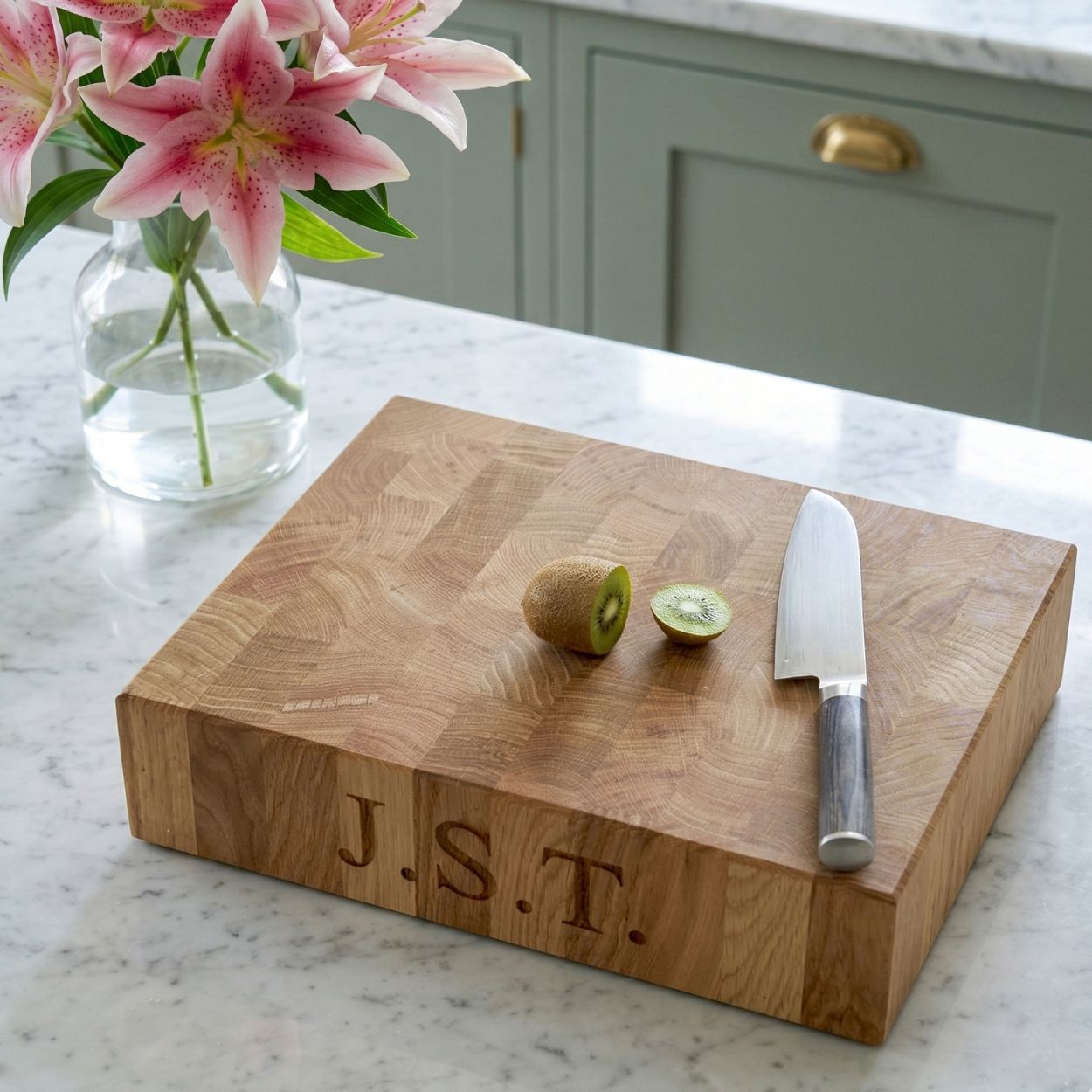
A typical chopping board is cut so that the long face of the timber, the side you’d see running along a plank, becomes the cutting surface. That’s known as face grain or flat grain, and it’s how most boards on the market are made. End grain works the opposite way. The timber is cut into strips, turned on its side, and reassembled so that the end of each piece of wood faces upward. Instead of cutting along the length of the wood fibres, your knife is cutting into the ends of them, which is exactly where the difference comes from.
Why It’s Kinder to Knives
When a blade hits flat-grain timber, it’s cutting straight across the fibres, which dulls the edge with every stroke. On an end-grain board, the fibres sit upright like a bundle of straws. The blade slips down between them rather than slicing across them, and the fibres simply flex apart and close back up once the blade lifts. This is usually described as a “self-healing” surface, and it’s the main reason end grain has been the standard in professional kitchens and butchers’ shops for as long as anyone can remember. Knives stay sharper for longer, and the cutting surface itself resists scarring in a way that flat-grain boards simply can’t match.
Built to Improve, Not Just Survive
End-grain boards are also remarkably durable. The construction resists deep scoring even under heavy daily use, and with regular oiling, the surface actually improves over time rather than wearing thin. It’s common to come across end-grain boards that have been in daily use for ten or twenty years and look richer now than the day they were made. That kind of longevity is rare in kitchenware, and it’s part of why an end-grain board tends to be treated less like a consumable and more like a long-term investment.
Oak or Walnut: A Different Look in End Grain
The chequered pattern that end grain is known for looks quite different depending on the timber. English oak produces warm, honey-toned squares with plenty of natural variation, giving the board a traditional, slightly rustic character. American black walnut, by contrast, gives a much deeper, almost chocolate-brown chequered surface that feels more contemporary and dramatic on the worktop. Both are excellent performers; the choice really comes down to which one suits your kitchen.
Beyond the Basic Board
End grain construction lends itself well to a few practical extras worth knowing about. A lipped edge lets the board overhang the worktop slightly, so ingredients can be swept straight off the edge into a pan. A solid hardwood frame around the chequered centre gives a board a more furniture-like finish. Cutout handles make lifting a heavy board easier, and a carved groove around the edge will catch juices if the board doubles up for carving. The density of end-grain timber also makes it a genuinely useful trivet, capable of taking a hot roasting tray or cast iron pan straight from the oven without any concern.
A Board Worth Personalising
Because end-grain boards are built to last decades rather than years, they tend to be the boards people choose to personalise. Engraved initials or a family name along the edge, a meaningful date, or a private message tucked underneath turn a serious piece of kitchen equipment into something that gets passed down rather than replaced. They’re a popular choice for weddings, housewarmings, and milestone birthdays, partly because they’re genuinely useful and partly because they look like they were chosen with real thought.
Caring for an End Grain Board
Hand wash only, never the dishwasher, and dry it standing up rather than flat so air can reach both sides. A food-safe oil worked into the surface every few weeks keeps the timber from drying out and helps that patina build evenly over time.
If you’re weighing up whether the upgrade is worth it, it’s worth browsing a proper range of end grain chopping boards to see the construction up close. Once you’ve used one, it’s genuinely difficult to go back.
