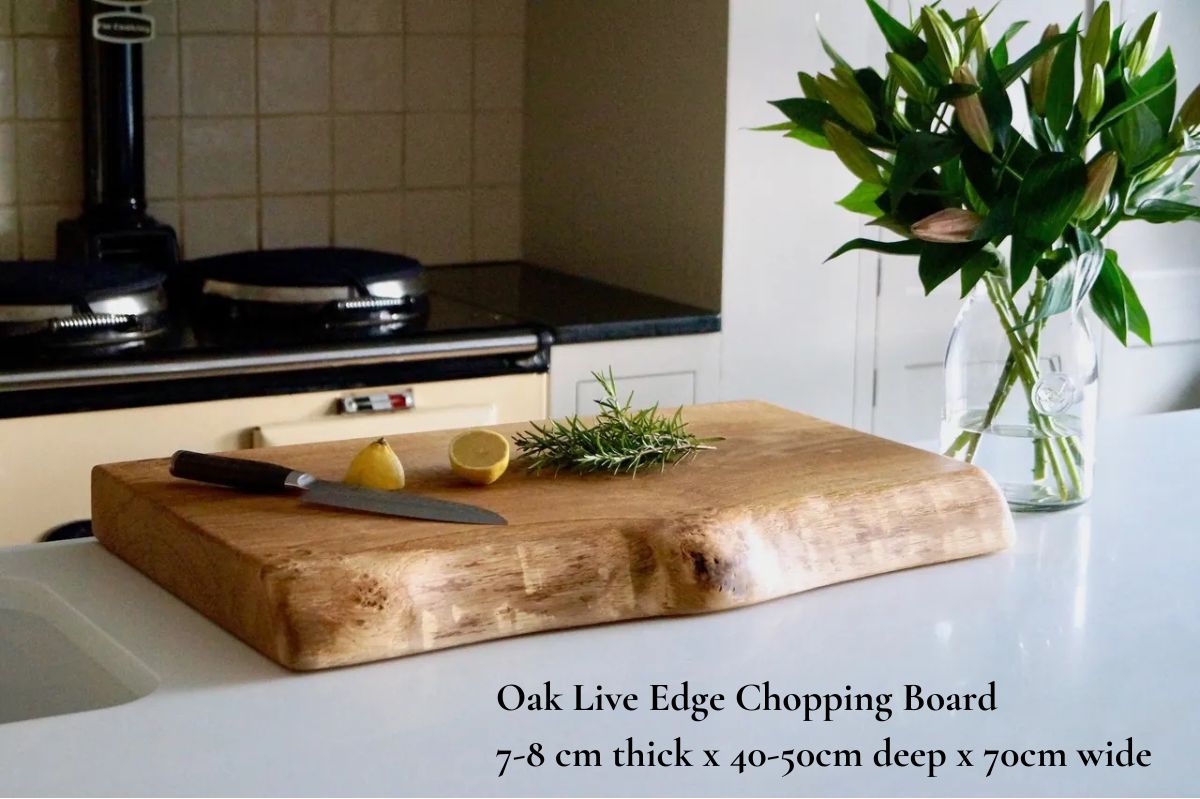
The short answer: for most home cooks, a board of around 40cm x 30cm is the right everyday size. It is large enough to handle most preparation tasks comfortably without taking over the worktop. If you regularly carve joints, prepare large quantities of food, or cook for a big household, a larger board of 50cm x 35cm or more will serve you better. When in doubt, go bigger: a board that is slightly too large is far more useful than one that is slightly too small.
Why Board Size Matters More Than People Expect
A chopping board that is too small for the task at hand creates two problems. First, it makes food preparation slower and more awkward, because ingredients keep falling off the edges and you are constantly repositioning. Second, a small board is less safe: a joint or a large vegetable that overhangs the edge of the board is unstable under the knife, which increases the risk of slipping.
Most people underestimate how much space they need when they are cooking. The cutting area you actually use is almost always larger than you think, especially when you are breaking down a whole chicken, slicing a large loaf, or prepping vegetables for several people.
The Right Size for Everyday Cooking
For day-to-day preparation, including chopping vegetables, slicing bread, preparing meat portions, and general kitchen tasks, a board of around 38cm to 45cm in length and 28cm to 32cm in width covers almost everything comfortably. This size sits well on a standard kitchen worktop without feeling unwieldy and is easy to wash and store.
If your worktop space is genuinely limited, a board of around 35cm x 25cm can still manage most everyday tasks, but you will notice the constraint when working with larger ingredients.
The Right Size for Carving and Large Joints
Carving a leg of lamb, a whole chicken, or a large joint of beef requires significantly more space than everyday prep. For carving, a board of at least 50cm x 35cm gives you enough room to hold the joint, carve without running out of space, and let the slices rest as you work.
A dedicated personalised wooden carving board is worth considering if you regularly cook large joints. These boards are designed specifically for the task, with juice grooves to catch the runoff and often with meat spikes to hold the joint steady while you carve. Using a purpose-built carving board on a dedicated surface makes the whole process safer, tidier, and considerably easier.
The Right Size for a Cheeseboard
A cheeseboard operates differently from a prep board. You need enough space to lay out several cheeses alongside accompaniments like crackers, grapes, and chutney, while still leaving the board looking considered rather than crammed. For a board serving four to six people, around 40cm x 30cm works well. For a larger spread or a more elaborate presentation, 50cm x 35cm or a large round board gives you room to build a proper display.
Browse our range of personalised wooden cheese boards for options across a range of sizes in both oak and walnut.
Thickness: The Dimension Most People Overlook
The length and width of a board get most of the attention, but thickness matters too. A board that is too thin, roughly under 2cm, will be noticeably more prone to warping and will feel flimsy under the knife. A thickness of 3cm to 4cm gives the board structural rigidity, a satisfying weight that keeps it stable on the worktop, and much better resistance to warping over time.
End grain boards, which are assembled from sections of timber turned on their side, tend to be thicker by construction and are inherently more stable than thin face-grain boards as a result.
Round vs Rectangular: Does Shape Matter?
For most preparation tasks, a rectangular board is more practical. The straight edges make it easier to push ingredients to one side while you continue chopping, and rectangular boards tend to make better use of worktop space.
Round boards work particularly well as cheeseboards and serving boards, where the shape contributes to the presentation rather than getting in the way of it. A large round board laid out with cheeses, fruit, and crackers tends to look more like a centrepiece than a rectangular board of the same area.
Size Summary
Choose a board that is a little larger than you think you need. For everyday prep, aim for at least 38cm x 28cm. For carving and larger tasks, go to 50cm x 35cm or beyond. Pay attention to thickness as well as footprint, and choose a size that suits the specific job rather than buying a single board and expecting it to do everything.
Take a look at our full range of personalised wooden chopping boards to find the right size in solid oak or walnut, with personalisation options to make it your own.
